How big is the Salar de Uyuni?
The Salar de Uyuni is known not only for its beauty but also for its extraordinary size. Many people wonder just how big this salt flat really is and why it’s considered the largest in the world. Its vast expanse, flat surface, and location on the Bolivian Altiplano make it a unique geographical phenomenon. Understanding its dimensions allows us to better appreciate the magnitude of this natural landscape and its global importance.
The actual extent of the Salar de Uyuni
The Salar de Uyuni is the largest salt flat on the planet, and its size is one of the aspects that most impresses visitors. It covers more than 10,000 square kilometers, an area so vast it’s difficult to imagine at first glance. To put it in perspective, the salt flat occupies a larger area than many cities and entire regions around the world.
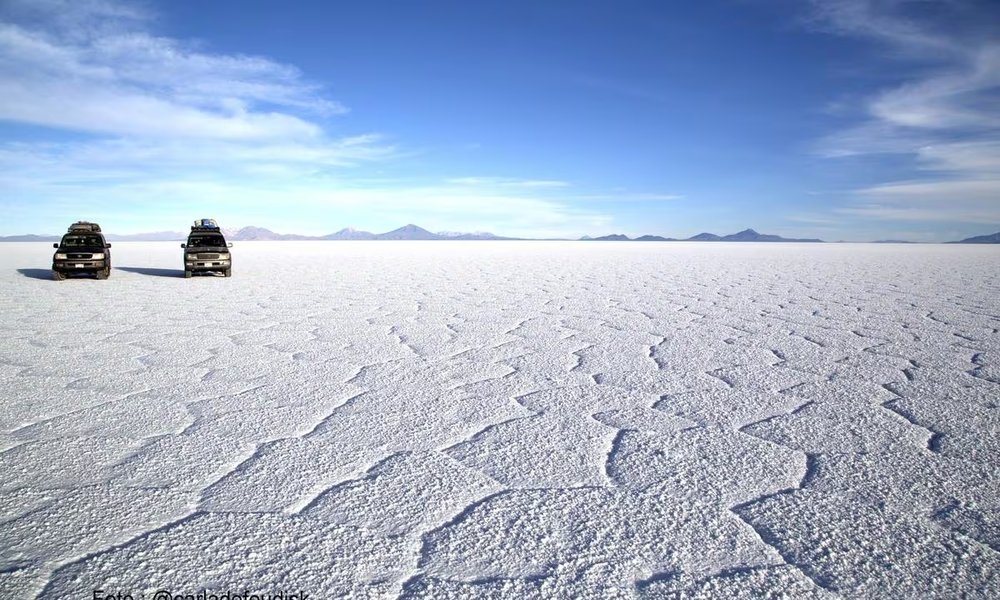
This vast salt flat stretches almost continuously and uniformly, without significant changes in elevation or visible interruptions. Thanks to this characteristic, traveling across it creates a feeling of absolute immensity, where the horizon seems endless. Even on long journeys by vehicle, the landscape remains constant for hours.
A flat, continuous surface
Besides its size, the Salar de Uyuni is notable for its exceptional flatness. The difference in altitude between different points on the salt flat is minimal, making it one of the flattest natural surfaces on Earth. This regularity is so precise that it has even been used to calibrate satellites and space-based measurement systems.
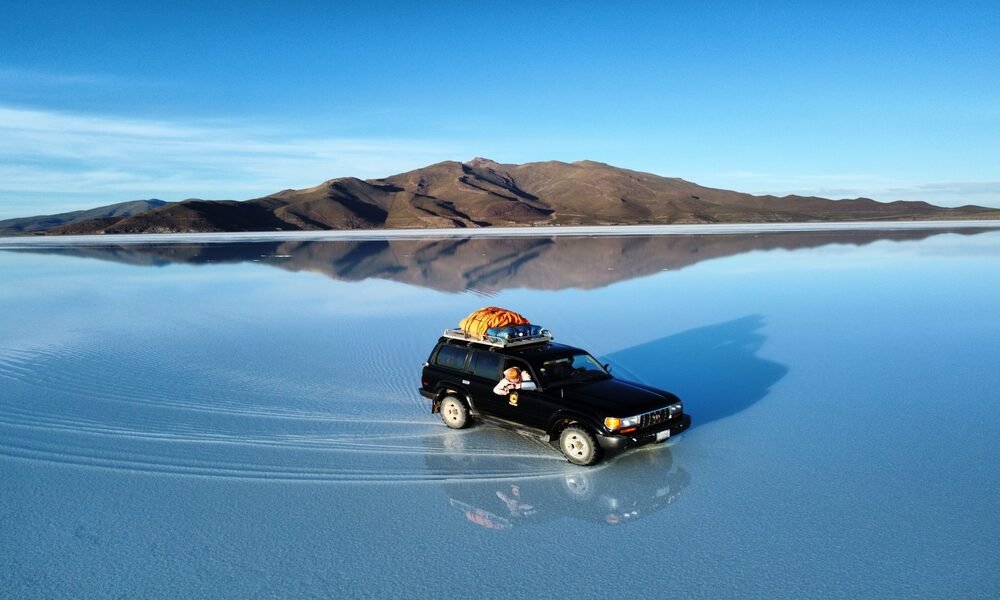
During the dry season, the salt forms geometric patterns that repeat for kilometers. In the rainy season, this same surface transforms into a giant mirror that perfectly reflects the sky.
Location and magnitude on the high plateau
The Salar de Uyuni is located more than 3,600 meters above sea level, in the heart of the Bolivian Altiplano. Its enormous size directly influences the perception of the landscape and the visitor’s experience. With no trees or buildings, the feeling of vastness is absolute.
For these reasons, when talking about the size of the Salar de Uyuni, we are not only referring to figures, but to a visual and spatial experience that allows us to truly understand how big this impressive salt desert is .
Comparison of the Salar de Uyuni with other salt flats and cities
To truly understand the vastness of the Salar de Uyuni, it’s helpful to compare it to other salt flats and well-known cities. These comparisons help to visualize its magnitude more clearly.
With an area of over 10,000 km², the Salar de Uyuni far surpasses other salt flats in the world. For example, it is several times larger than many salt flats in Chile, Argentina, or the United States, which tend to be much smaller and more fragmented.
Comparison with other salt flats in the world
The Salar de Uyuni is considerably larger than the Salar de Atacama or the Salar del Hombre Muerto. Furthermore, its surface is much more continuous and flat, reinforcing its reputation as the largest salt flat on the planet.
While other salt flats have irregular zones or partially covered areas, Uyuni extends like an almost perfect plain, without visible interruptions for kilometers.
Comparison with cities and regions
In urban terms, the Salar de Uyuni is larger than entire cities like Metropolitan Lima, Bogotá, or Buenos Aires. It even exceeds the area of some small countries or entire administrative regions.
This comparison helps us understand that traveling across the salt flats is not just visiting a tourist spot, but moving across a gigantic area, where journeys can last for hours without leaving the same landscape.
Why the size of the Salar de Uyuni influences the mirror effect
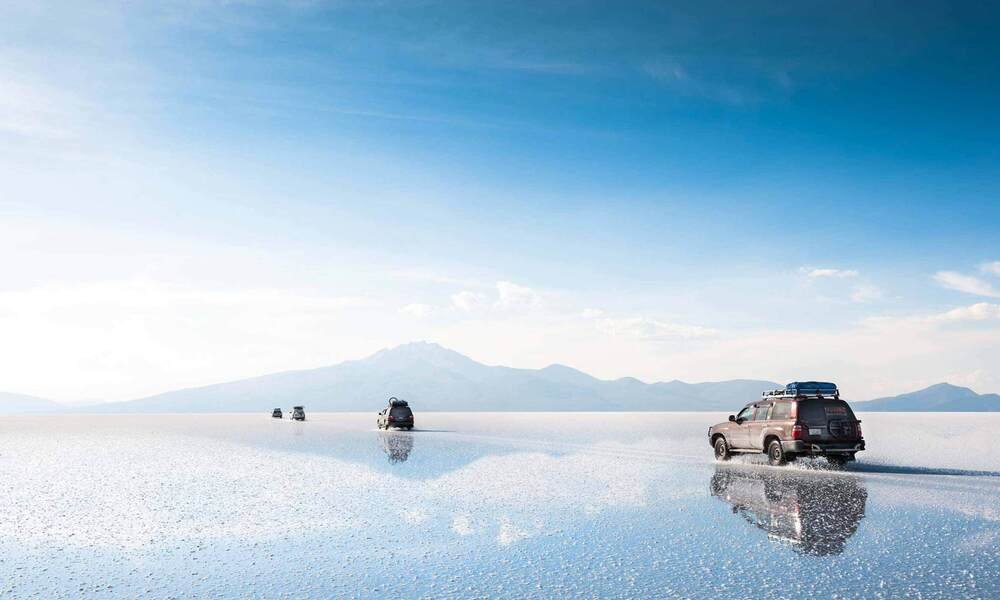
The size of the Salar de Uyuni is a determining factor in the production of the famous mirror effect. It’s not just the presence of water, but the enormous, continuous, and uniform expanse that allows the reflection to remain uninterrupted.
Unlike other smaller salt flats, Uyuni offers such a wide surface that the reflection of the sky can extend for kilometers, creating the illusion of an infinite mirror where the horizon disappears.
Continuous uninterrupted extension
The vast expanse of the salt flat avoids visual interruptions such as mounds, vegetation, or abrupt changes in elevation. Thanks to this, the thin layer of water is distributed evenly over a huge surface, allowing for a clean and continuous reflection.
In small salt flats, water tends to accumulate unevenly, breaking the mirror effect. In Uyuni, its size guarantees a visual uniformity that is difficult to replicate elsewhere.
Relationship between size and flatness
The size of the Salar de Uyuni is directly related to its almost perfect flatness. Because it is such a vast and extremely flat surface, the water doesn’t concentrate in specific areas, but rather forms a thin, stable sheet.
This combination of large size + minimal height variation is the main reason why the mirror effect achieves such a level of perfection and remains visible over large areas at the same time.