


Best month to find snow on Nevado Salkantay
The Nevado Salkantay is one of the most impressive landscapes in the Cusco region and one of the most emblematic mountains on the way to Machu Picchu. Its imposing presence is part of one of the most recognized treks in Peru, offering Andean views of great beauty along the entire route. Although snow remains throughout the year in its highest areas, the experience of observing it varies considerably depending on the season, since weather conditions directly influence visibility, access, and the way the landscape is appreciated during the journey.
Most recommended time to travel
The dry season in the Andes mountain range is considered the most favorable time to travel the Salkantay route, especially if the goal is to appreciate the snow-capped mountain at its best. During this time, the environment becomes more predictable and allows the traveler to enjoy cleaner visual landscapes, with fewer weather interferences that hinder the view of the mountain.
The most recommended months to plan the trip are:
- June
- July
- August
These months coincide with the Andean winter, a season characterized by reduced rainfall and a greater presence of clear skies. This not only improves the visibility of the snow-capped mountain but also allows a better overall trekking experience, since the paths remain more stable and with less presence of mud or landslides.
During this period, weather behavior directly influences the quality of the landscape observed by the visitor. The mountain usually appears with greater sharpness, and lighting conditions favor photography and observation of the natural environment.
At this time, clear advantages can be noticed such as:
- Greater probability of clear skies during much of the day
- Less moisture accumulation in the environment
- Wider visibility of the mountain range and nearby glaciers
- Firmer and more passable trails for trekking
- More defined landscapes from different points of the route
In addition, the thermal sensation tends to be more stable compared to the rainy season, where weather changes can be sudden and constant. Although temperatures at altitude remain cold, the dry environment makes the hike more manageable and predictable.
For these reasons, this period is the most chosen by travelers and tourism agencies, since it combines safety on the route, better visual conditions, and a more complete experience of the Andean landscape around Nevado Salkantay.
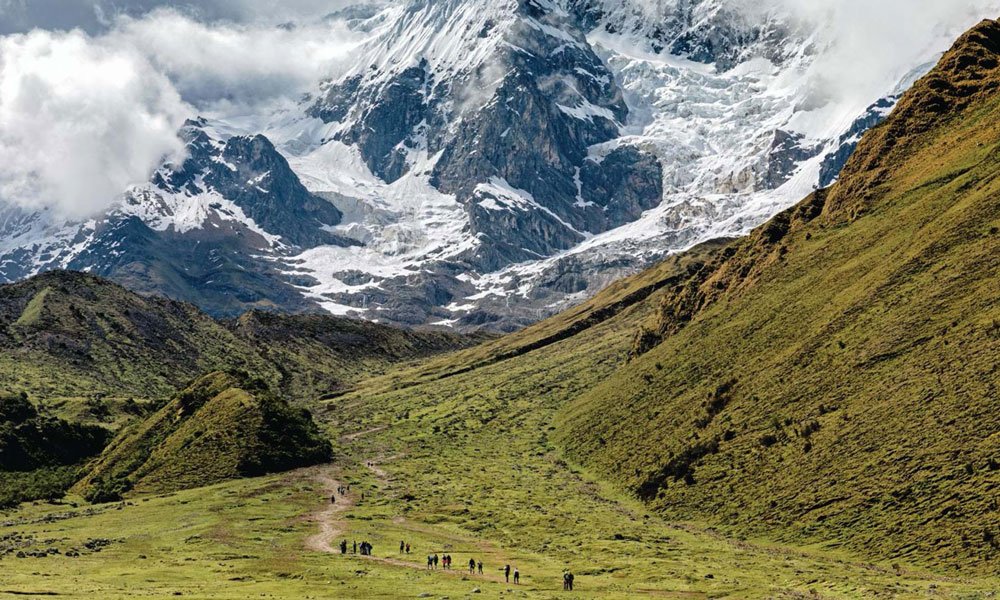
How the snow-capped mountain looks in these months
During the dry season, the appearance of Nevado Salkantay changes notably, offering a much clearer and more defined view compared to other times of the year. The combination of low humidity and less cloud presence allows the mountain to be appreciated in greater detail from different points of the trek.
In these months, the landscape is characterized by better visual definition of the surroundings, which allows the forms of the snow-capped mountain, its slopes, and the layers of ice covering it to be distinguished more precisely.
Some highlighted aspects in this season are:
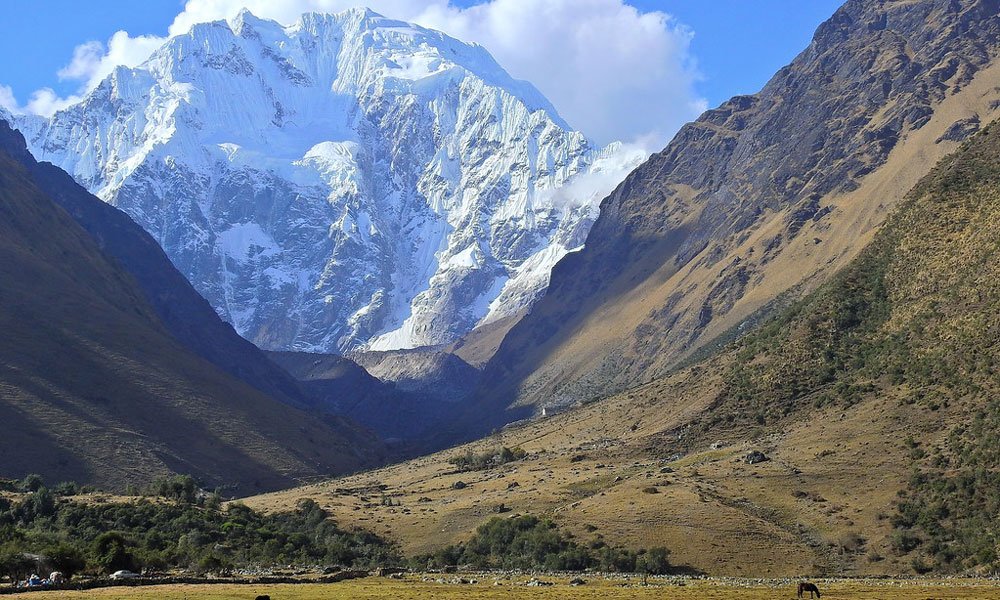
- The snow presents a whiter and brighter color due to greater exposure to sunlight
- The surrounding mountains are observed with greater sharpness, without loss of detail from mist
- The contrast between the blue sky and the snow-capped mountain is more marked, highlighting the imposing landscape
- The valleys and trails are perceived as more open and wider during the journey
Another important point is that the atmosphere is usually cleaner, which significantly reduces visual interruptions. This allows the traveler to have a more continuous view of the snow-capped mountain throughout the trek, without sudden changes caused by dense clouds or fog banks.
Overall, these conditions make the experience more intense visually, since the landscape appears more consistently, allowing one to appreciate Salkantay in all its natural splendor during the hike.
Weather conditions in this season
During the dry season on the Nevado Salkantay route, the climate is more stable than in the rainy months. This allows trekking to be carried out in better overall conditions. Although altitude keeps temperatures cold all year round, the main difference is the lower presence of rain.
The landscape appears clearer and more open. The trails are also in better condition. This allows a more continuous hike with fewer weather interruptions.
In this season, conditions include:
- Less presence of rain during the day
- Better visibility along most of the route
- Firmer trails with less mud
- Clearer skies for several hours
The climate is also more regular. Changes between sun, wind, and clouds are less frequent. This helps make the hike more predictable.
Regarding temperature, the cold remains due to altitude. However, variations are smoother during the day:
- Cold temperatures typical of high-altitude areas
- Cold mornings with gradual improvement with sunlight
- Fewer sudden weather changes during the route
These conditions are part of the typical Salkantay climate in the dry season. They also directly influence the way the landscape is appreciated during the trek.
Why these months are the most chosen
During the dry season on the Nevado Salkantay route, the climate becomes much more favorable for trekking compared to other months of the year. Although altitude always maintains cold temperatures, the great advantage of this period is climate stability, which allows a more comfortable and predictable experience for the traveler.
In general terms, the environment presents cleaner and safer conditions for walking, since reduced rainfall improves both visibility and trail conditions.
Among the main characteristics of the climate in this season are:
Main climate characteristics in this season
- Less rain compared to the wet season
- Better visibility from trails and natural viewpoints
- Firmer trails with less mud
- Clearer skies for much of the day
These conditions make the route smoother, since the landscape remains visible for longer and there are fewer interruptions caused by fog or precipitation.
Another important point is thermal stability. Although the cold remains constant due to altitude, sudden weather changes are less frequent, which helps make the trek more organized and predictable.
Temperature behavior in this season
- Cold but more stable temperatures at altitude
- Cold mornings with gradual improvement during the day
- Fewer sudden changes between sun, wind, and clouds
Overall, these conditions make the Salkantay experience safer and more pleasant, allowing the visitor to focus on the landscape rather than on weather changes in the environment.
The Nevado Salkantay is a destination that offers a unique experience throughout the year, but its best version is seen in the dry season. During these months, the more stable climate allows for better visibility, trails in better condition, and a much clearer and more striking Andean landscape.
Although the cold is constant due to altitude, the general conditions make the trek safer, more organized, and more visually attractive. Therefore, planning the visit between June, July, and August allows you to make the most of the route and observe Salkantay in all its natural splendor.